Stats From one Year of Film Photography
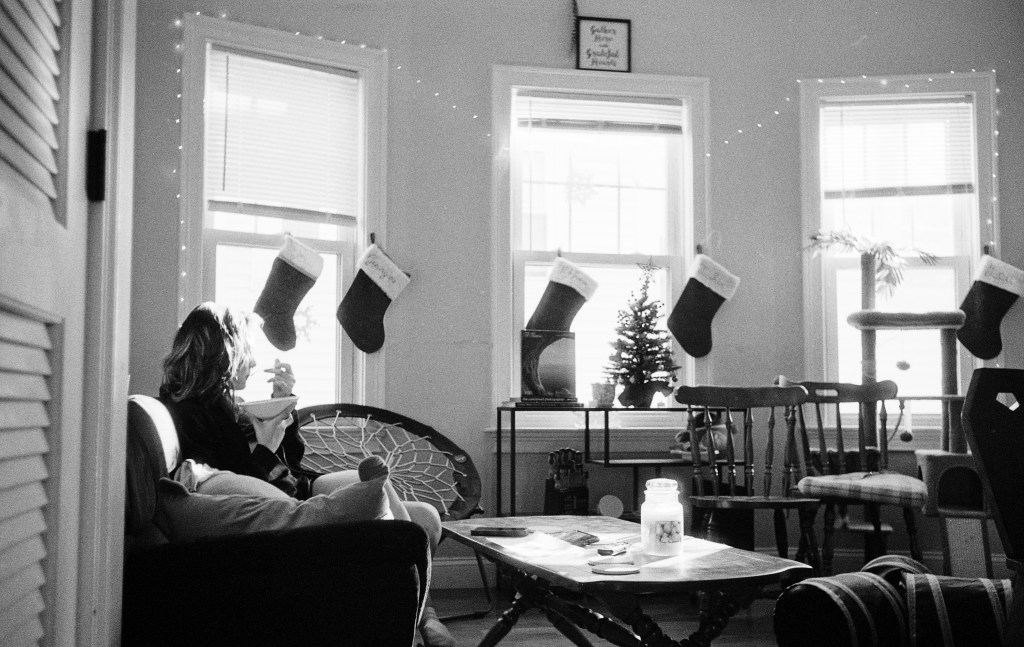
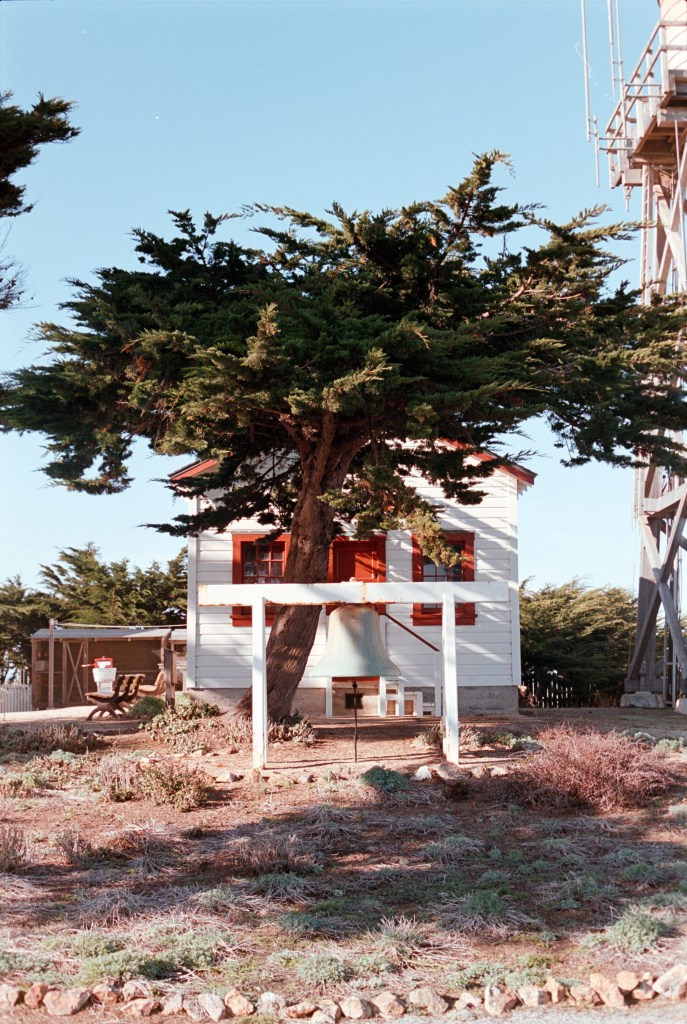
Caption: Unrelated recent photo from the Leica iif. My two most recent film rolls have contained pretty uninspired results, but this one turned out fairly well.
This is a more mathematical and nerdier followup to my previous post reflecting on one year of film photography. Ever since I started shooting film I’ve been collecting, sorting, and storing all my negatives in an e-Tone binder. Each roll is labeled denoting the approximate month/year in which the photos were taken, which camera was used, and where the photos were captured. This roughly systematic documentation has allowed me to create a spreadsheet and subsequently make some interesting plots. Here we’ll be going through those plots to see if we can learn anything.
Film Roll Metrics and Data Recorded
For each roll of film I recorded the following values and labels in a google spreadsheet.
| Value | Date | Camera | Film Stock | B&W or Color? | Location | Film Cost | Dev Cost | # Good Photos | Rating | Issues? |
| Type | mm/yy | label | label | Binary B&W/Color | label | $ | $ | number 0-36 | number 0-10 | Binary yes/no |
Objective Metrics: All of these values from “Date” to “Dev Cost” are objective and immutable. The only slight grey area is “Film Cost” where I used values based largely upon what I remember paying for them and values from B&H. Unfortunately most of the stores in Boston, especially catlabs, tend to increase their film prices a bit, so these numbers may be a bit higher than they have to be. Below is a plot of how I priced each film stock. I would just directly display the table in this post but the table editor for WordPress is actually abhorrent. It would be impressive to see someone create a worse system.
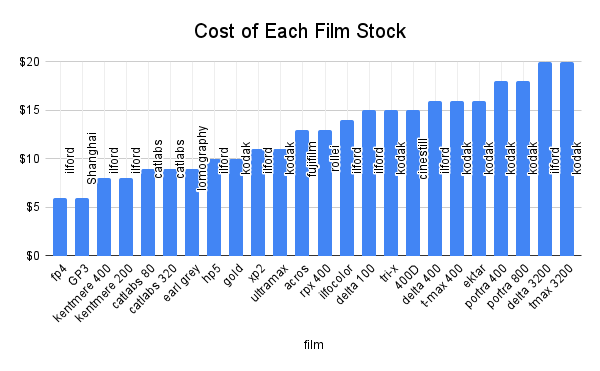
Caption: Chart plotting the price I assigned to each film stock. There are definitely some super inflated prices here, but that’s just because I was a fool and over paid. Also this is the only plot I made in google sheets which is why it’s so ugly.
The last metric here of note is “Development Cost”. For this I’m only counting the cost of getting rolls developed externally at a lab, I’m not taking into consideration the cost of any home development chemicals. As far as I understand home dev would add less than $1 per roll for development cost, so I found it not too important to include.
Subjective Metrics: The remaining metrics are a bit more subjective. I visually went through each roll and determined the number of pictures which I found to be “good”, using whatever satisfied me at that time. I considered a photo to be “good” if it was generally interesting and or brought some good memories. I think I was fairly lenient in what I determined to be “good”.
The next one is “Rating” where I rated my satisfaction with the roll on a scale of 0 to 10. This one is even more subjective than “# Good Photos” since it also takes into consideration how good I think each photo is, not just how many good ones there are. So a roll with 6 amazing photos (to me) might get a higher score than a roll with 12 “good” but not outstanding photos.
Last is “Issues?” which denotes whether the roll had any technical issues present on it that resulted from things outside of setting exposure and pressing the shutter button. Examples include severe under development, light leaks, scratches on the film, shutter drag issues, etc. I do not consider any issues with scanning since those can be rectified with a re-scan and aren’t permanent.
So What’s the Damage?
The first thing you’re probably wondering is how much I spent this last year on film. Well overall I shot 59 rolls of 35mm and 120 film, of these 59 rolls I developed 50 at home and had 9 developed by Catlabs in Boston who charge $10 per roll. Overall this resulted in a total cost of about $790 for the entire year or about $66 per month, not too bad but not cheap either.
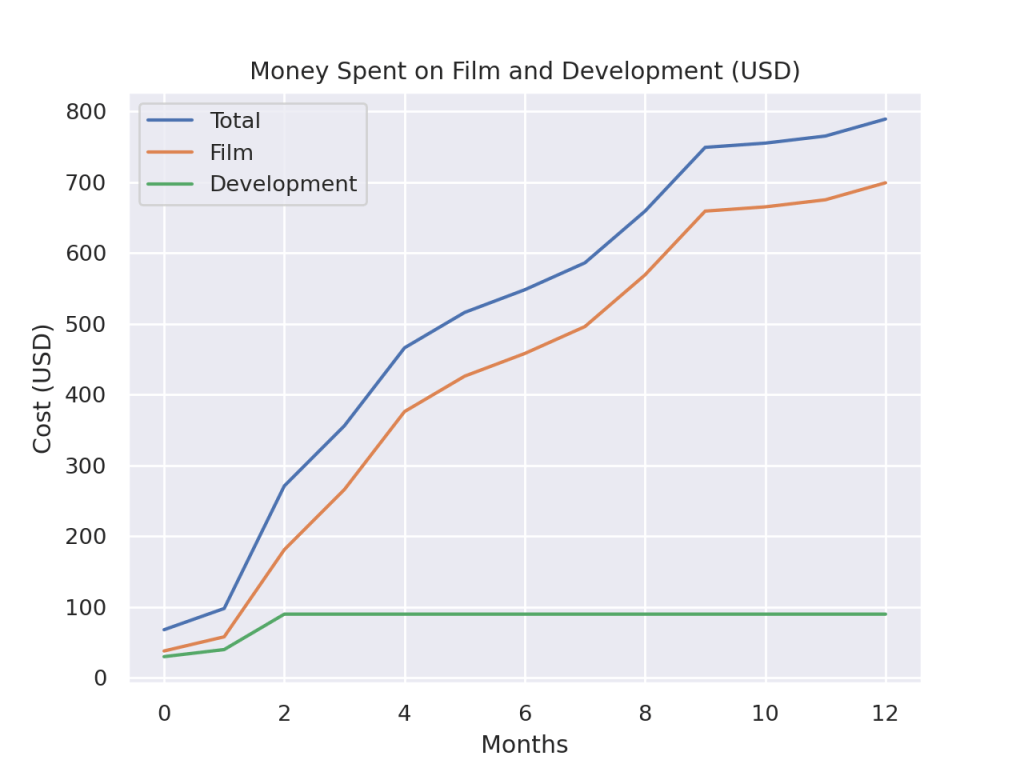
Caption: Plotting how much I spent on film and development over the last year. Here “Months” on the x-axis represents months since October 2024.
In addition to just showing how much money I spent, I think the plot above also tells a bit of a story about my excitement over time. The shape of the “Total” curve isn’t quite linear, instead starting with a quick rise and gradually flattening between months 4 and 7. If we were to continue this trend from month 7 we can imagine a log(x) or sqrt(x) type shape beginning to form. Months 7-9 were around the time I went on conference travel to ICML in Vancouver and visited my Uncle David in California, so a bit more film was shot around this time, resulting in the sharp increase. After that period I was pretty burnt out, having traveled to two conferences, ICML and RLC, back-to-back and finishing up a paper submission to ICLR so we see that very few rolls were shot between months 9-12.
Another factor here might be myself becoming a bit more conservative with how much I was spending on film, focusing on buying cheaper film stocks rather than experimenting too much with pricier options. Kentmere 400 and 200 help a lot with this since they’re some of the cheapest film stocks out there yet remain high quality and versatile.
Black and White vs Color
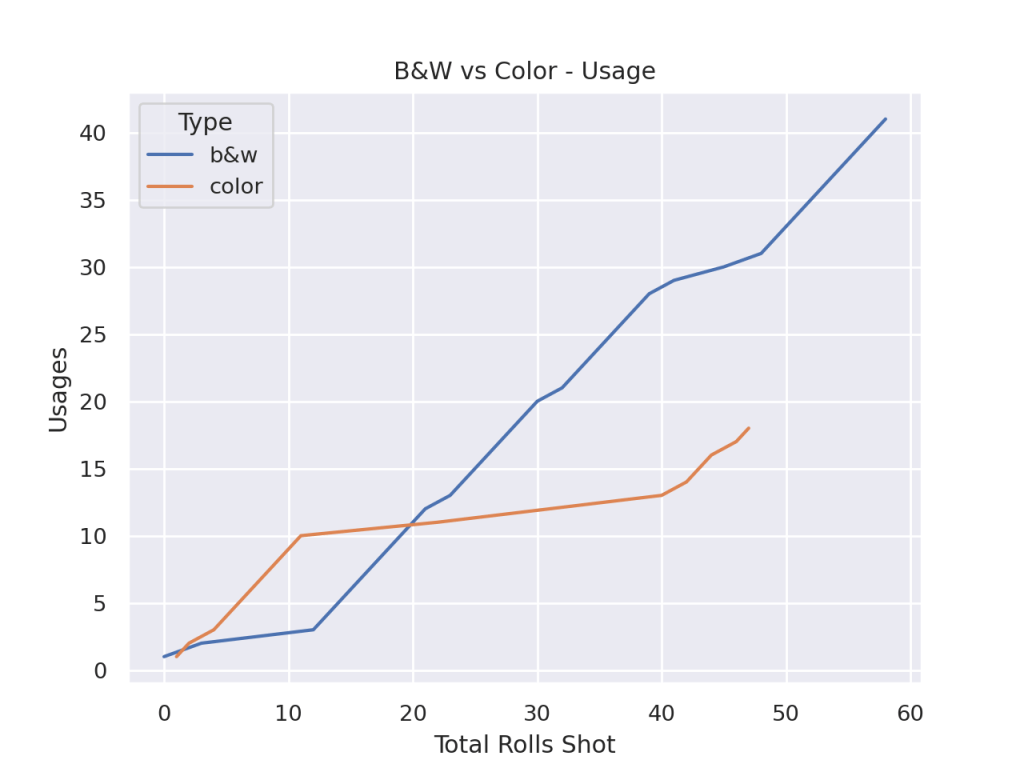
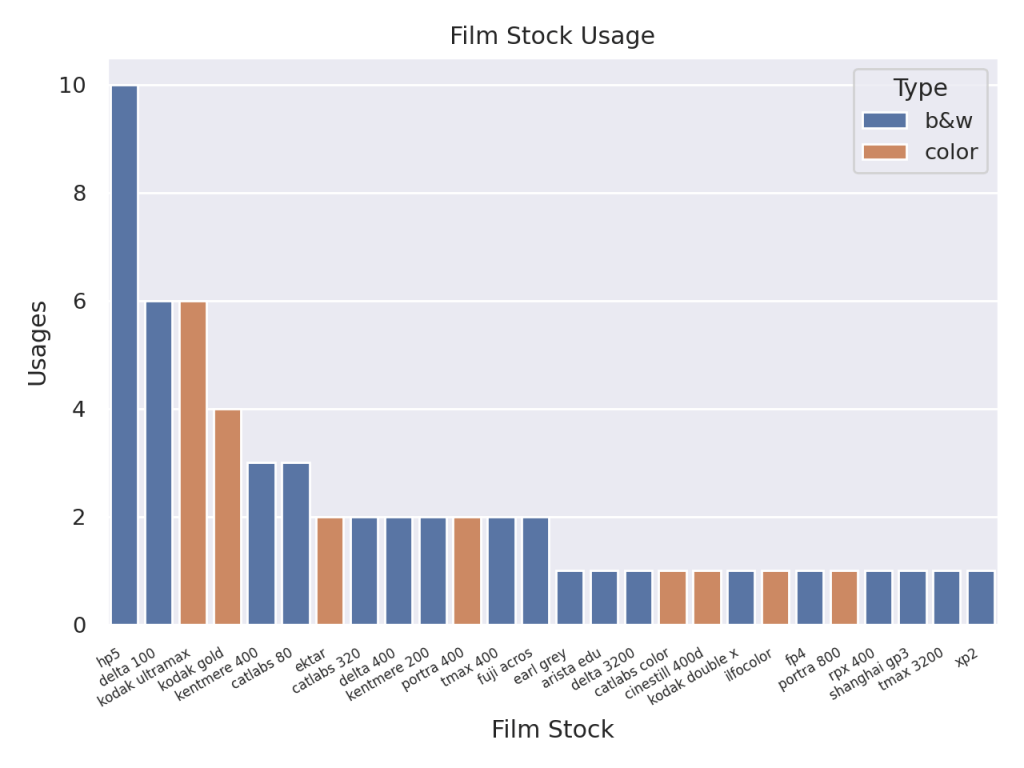
Caption: (Left) My usage of Black and White vs Color film over time. (Right) Overall usage of each individual film stock.
Next we’ll compare my usage of each film stock over time. Early on I was shooting primarily color film, with the mentality “what’s the point of black and white when we have color”, but that mentality has clearly changed as the plot shows. Around roll 11 I ceased shooting color film for a number of months and began shooting nearly exclusively black and white. This is also reflected in the bar plot on the right, where I experimented with far more B&W film stocks, and used Ilford’s HP5 and Delta 100 the most by far. Kodak Ultramax also saw a lot of usage, but the main reason there is that I was gifted a large amount of it for Christmas.
I think my shift towards B&W comes down to a lot of factors. First of all, B&W is far easier to develop at home, requiring little temperature management and far less toxic chemicals. This allowed me to create my own B&W developing setup at home to save some money. I also became a bit frustrated with color film around this time. It’s hard to describe but I never quite got what I was looking for out of many of my color photos, like the color wasn’t adding much extra value over raw luminance.
This also coincided with me switching my development process from Catlabs to “home style” development and scanning with my friend Jack Doerner. While development isn’t much of an issue, and scanning isn’t particularly challenging, it’s the conversion of color negatives to digital positives that remains a mystery to me.
At a base level one simply has to invert the lighting curve in their software of choice, setting the high exposure values on the negative to low exposure on the positive, and vice versa. The problem is that this isn’t enough, simply inverting the curve results in positives with a strong, typically blue colored cast over them, a result of the film negative’s orange base. This requires you to play a rather confusing game of color manipulation, the solution to which still evades me. Getting satisfying colors feels like performing some alchemical transmutation, where cause and effect is ambiguous and outcomes even more so. It’s hard to say what “correct” colors are, and I never find any of the options to be quite satisfying.
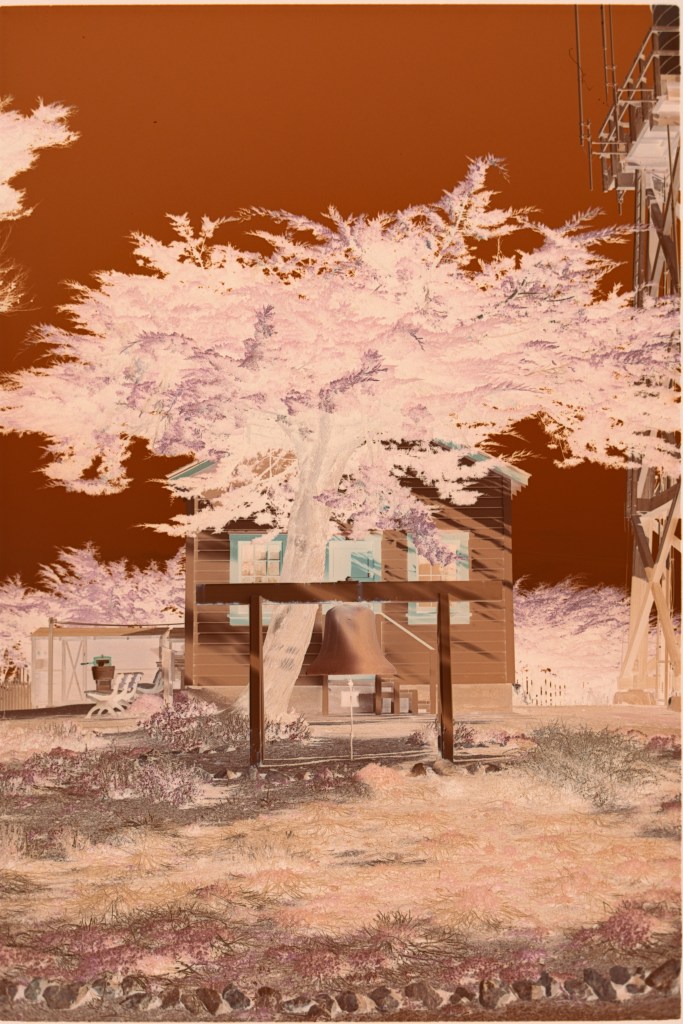
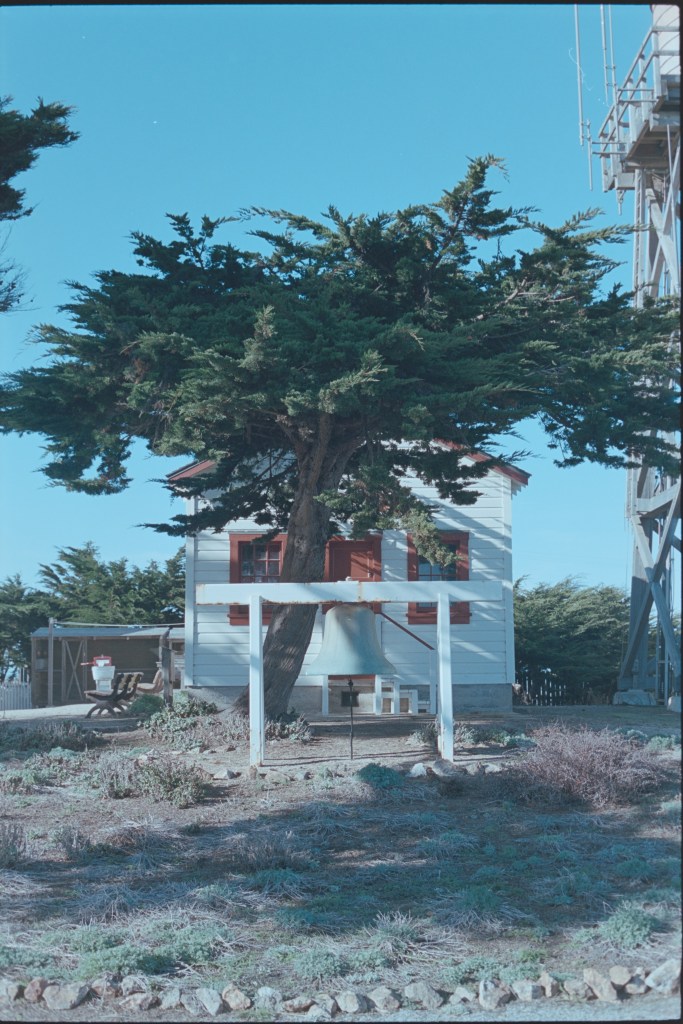
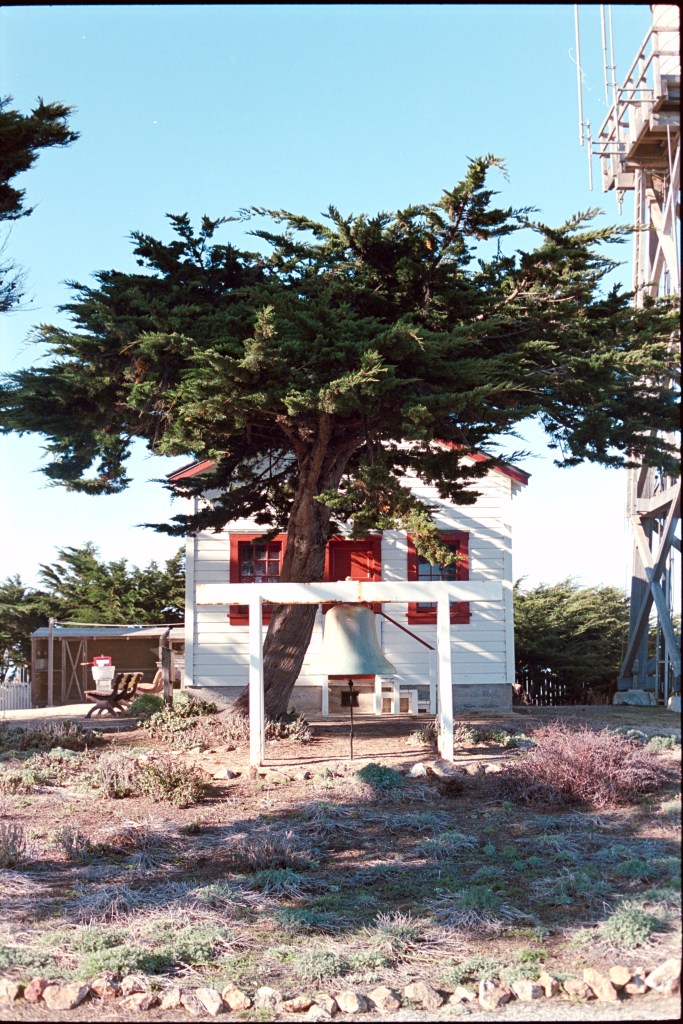
Caption: Visual example of converting color negatives to positive. On the left we have my raw, digital scan of the negative which shows the image’s overall orange color. Next we see the result of a direct conversion of the negative to a positive, additionally using the white balance tool to remove some of the blue cast, despite that the image is certainly still too blue. The next image shows my attempt to properly balance the colors and exposure while the last frame shows the results that came out of “Negative Lab Pro” which automatically converts color negatives to positive. It’s unclear which of these two results are better, but I think NLP does a better job of capturing the warm tones present in real life while mine is still a bit blue.
There are also a lot of external factors here that are hard to wrap your head around. For one, the color profile of the backlight you use during scanning has a pretty significant impact on the color tones that come out of the final positive. Jack Whittaker has a great write-up on this which also serves as a promotion for his proposed scan light with RBG lighting rather than pure white light. This just adds another dimension to the nightmare that is color negative scanning and conversion, which makes my head spin. Maybe at some point I’ll have more time do to more testing and really figure out what setup works best for me. For the meantime I’ll just stick to Black and White.
Speaking of, I think another factor in my preference towards B&W over color is that I enjoy the often mysterious and more somber feelings that come with B&W images. I much prefer photos that pose questions rather than those that look pretty, and I feel that B&W does the best job of this. Color can certainly achieve the same thing, but I sometimes find it to be more distracting and leaning more towards aesthetic rather than emotional weight. That being said, a lot of this is probably due to lack of vision rather than a fault in the medium as I don’t necessarily look for or think about colors while taking photos.
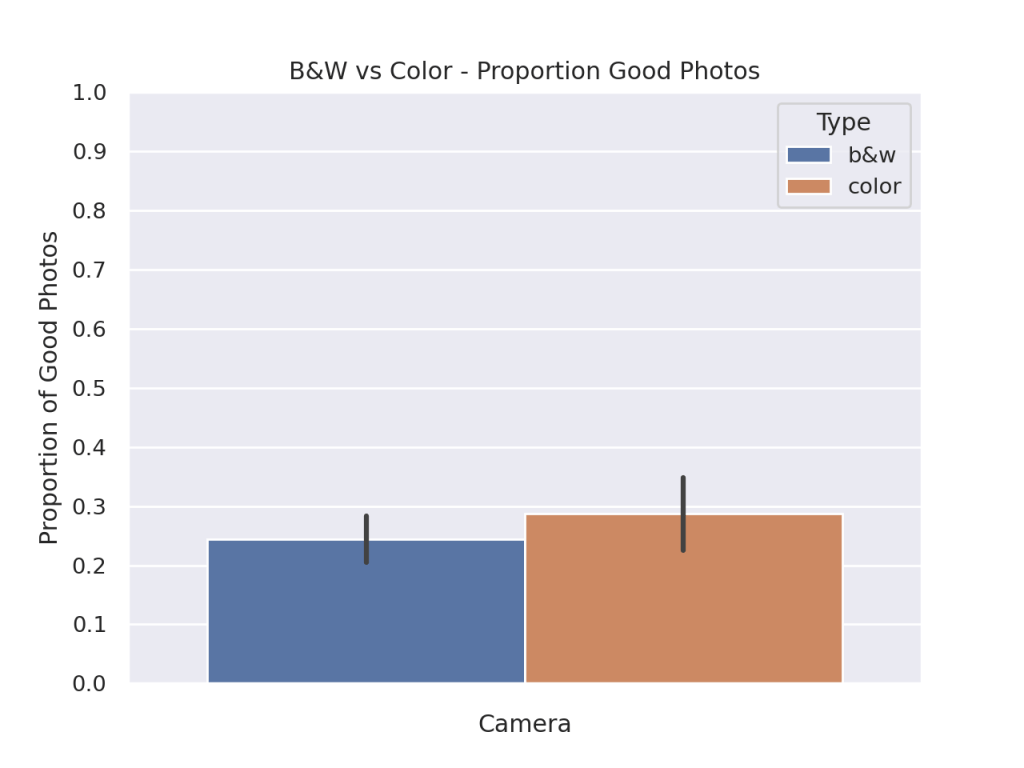
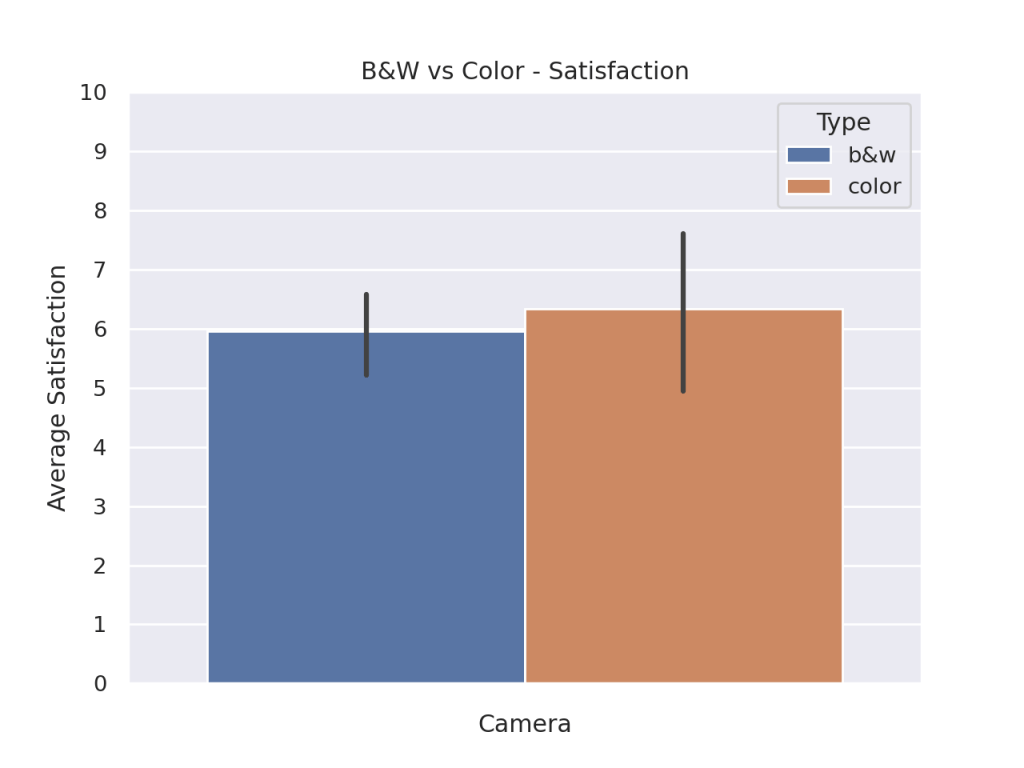
Caption: Comparison of my satisfaction with B&W vs Color film on average.
Interestingly, though, the above plot actually shows that I was more satisfied with color film on average. I think this is likely a byproduct of sample size as I shot way more B&W film and therefore had way more failures to decrease the average score. As far as I remember I only really had one roll of color film that was a complete failure, while all others went fine for the most part.
I’d say that out of all the film stocks I’ve used I don’t really yet have a favorite, but I think that some of my best results have come from either Kentmere 400 or Delta 100 for B&W, while for color I’ve gotten the best results out of Kodak Gold.
A Clash of Cameras
With this data I’m also able to visualize how many rolls I shot through each camera, telling a nice story of when each camera came into my life and how much I enjoyed shooting them.
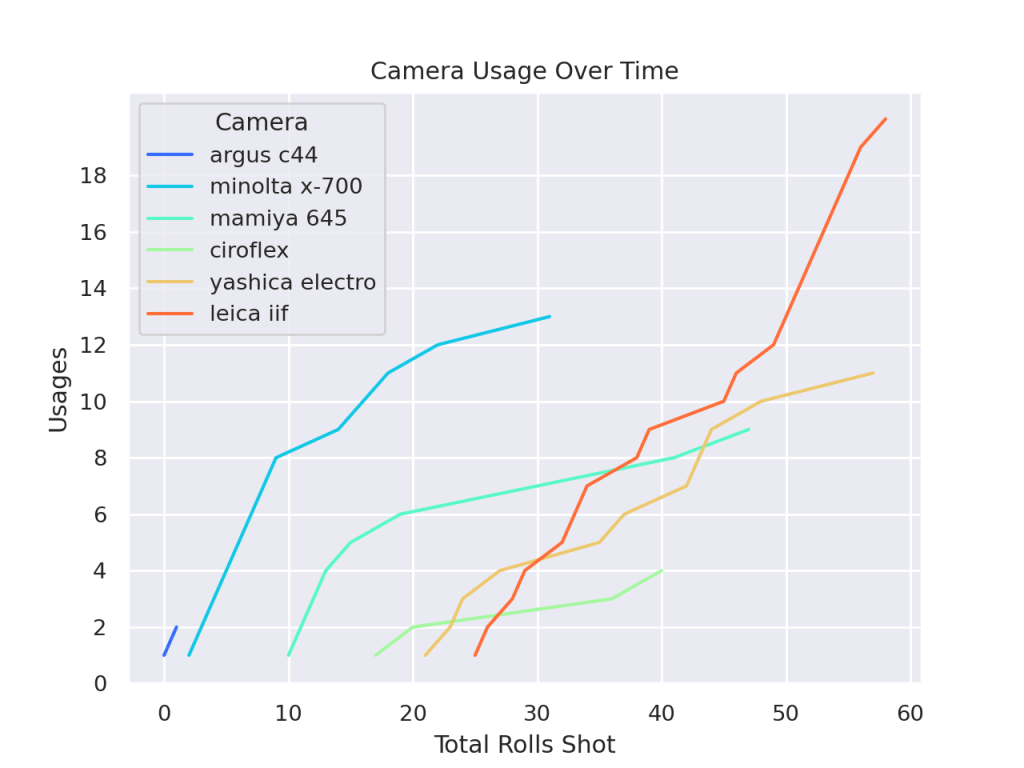
Caption: How many film I shot through each camera over time.
For myself not much of this plot is necessarily shocking, but it’s still a nice representation of the value each camera bought me. We can see the “eras” of each camera in a sense. The most clear example of this is my shift from shooting the Minolta X-700 to the Leica iif, where the Minolta saw essentially no usage after I got the Leica. It’s also cool to see how multiple cameras are maintained in my rotation, with the Leica, Mamiya, and Yashica all seeing usage over a longer time scale. The Leica is by far my most used camera, though, with its usage growing at a perhaps shockingly fast rate over the other cameras. As I went over in my previous post, the Leica definitely brought a new sense of excitement to my photography that was starting to wane towards the end of the Minolta era. This is in addition to its portability making it just that much easier to bring on quick trips and walks. That being said, I actually had a pretty rocky start to my relationship with the Leica, as I went through in my earlier post.
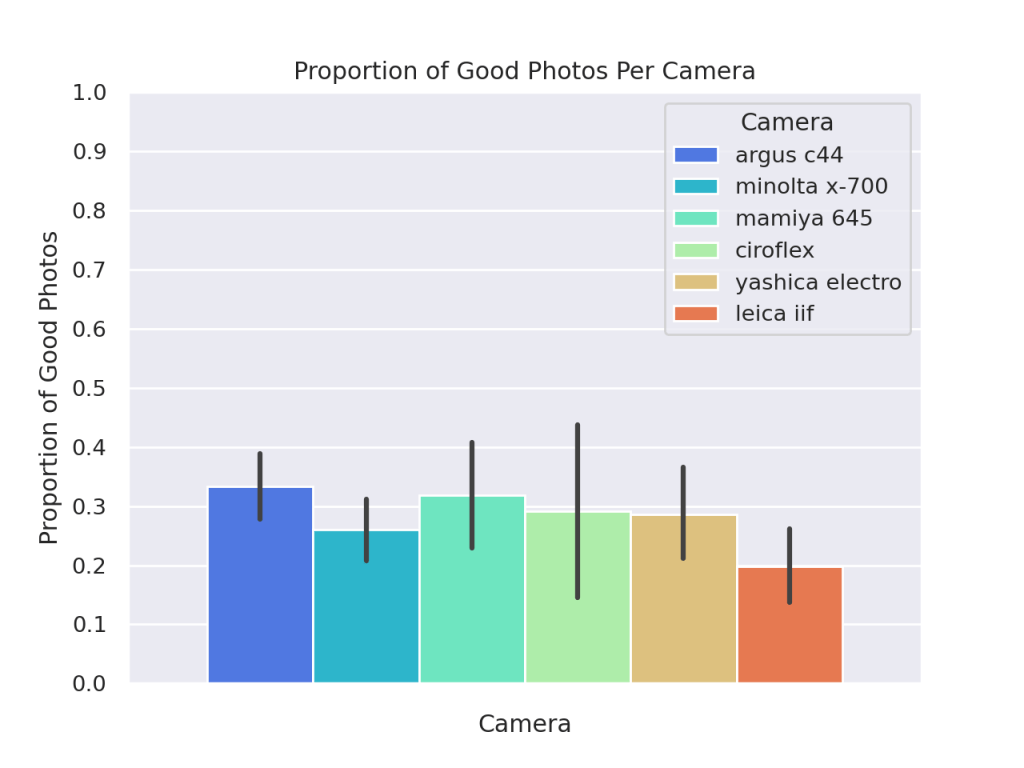
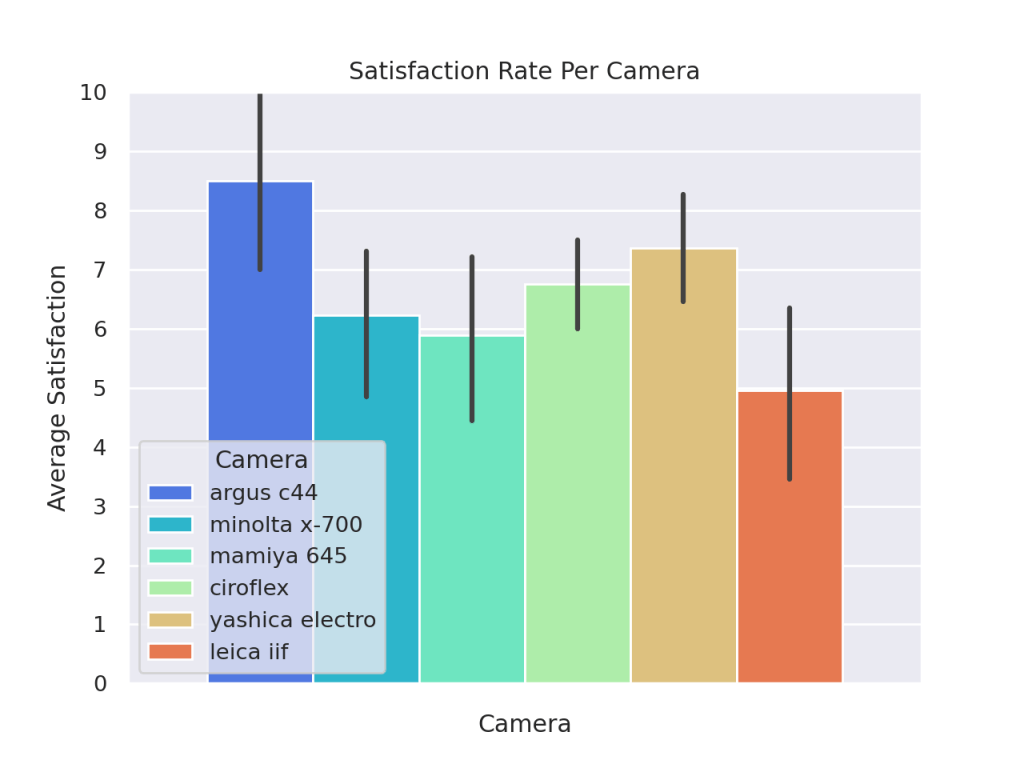
Caption: (Left) Ratio of “good photos” per photo taken on each camera, computed as total # good photos / total # photos overall. (Right) Average satisfaction rate per roll per camera.
We can see this pretty clearly in the above plots, where the Leica has the lowest satisfaction rate and proportion of good photos out of any of my cameras. This is a result of many failed or nearly failed rolls that came out of that camera as I sorted out its mechanical issues. The surprise winner here is the Argus, with an average satisfaction rate of 8.5/10, though this is a direct result of its low sample size of 2 rolls.
Ignoring the Argus as an anomaly, the Yashica is a clear winner in terms of average satisfaction. As I talked about in my last post, the Yashica is super reliable and consistent in terms of performance so I’m seldom disappointed. Strangely the Mamiya has the highest score in terms of “Proportion of Good Photos” while it falls behind in terms of average satisfaction per roll. I think this shows pretty clearly that, while I may have gotten some decent photos out of the Mamiya, I was never fully satisfied with the results and rated even “good” photos as just okay. I’m hoping to change this soon since I just invested in a new 45mm lens that’s super clean optically.
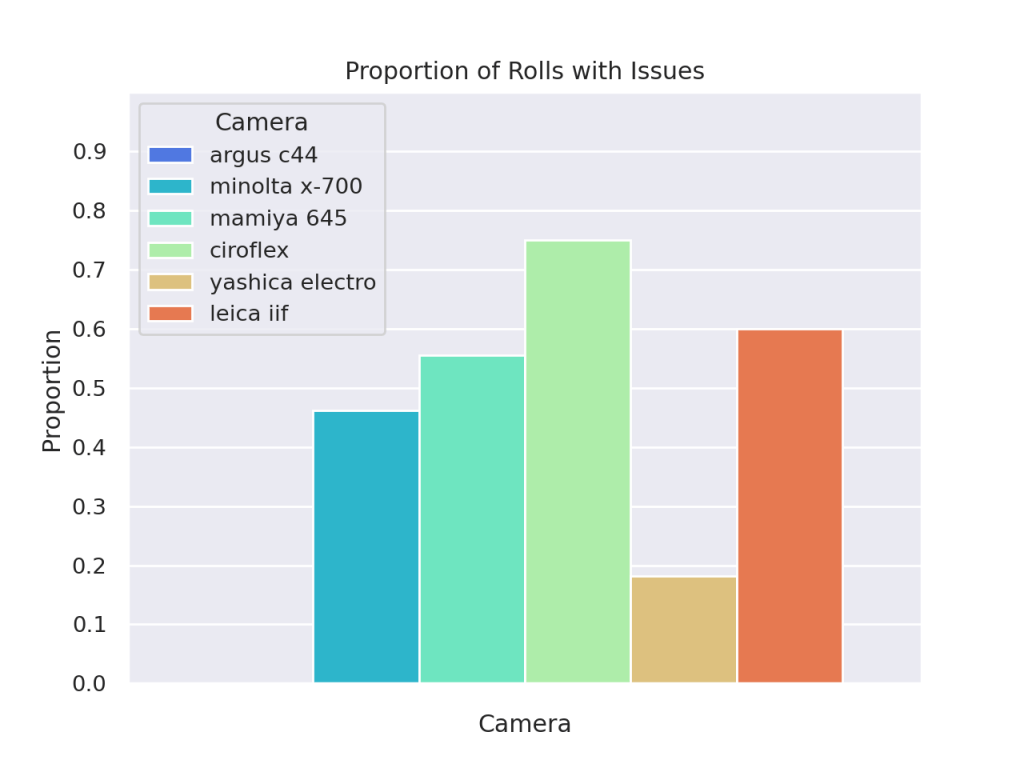
Caption: Frequency of mechanical or development issues from each camera.
We see some similar story lines as well in the above plot. Here I’m showing the proportion of developed rolls I got back, per camera, that had mechanical or development issues. Surprisingly the majority of rolls I got back had some kind of issue apparently. Notably the Ciroflex has the highest rate of mechanical issues since nearly every roll that comes back out of that camera has vertical scratches running down the film. Also the Leica, as I mentioned before, had plenty of issues with the shutter which show up in this plot as well. Of course the Yashica had basically no mechanical issues, but it still had some rolls marked as having development problems. Lastly the Argus doesn’t even show face on this plot since both of the two rolls I shot through it came back perfectly clean.
Camera Gear Data
In addition to the above film roll metrics, I also went back through all my camera receipts and recorded when I bought each piece of camera gear and how much I paid for them. I think there may be a few items missing, mostly the few items I did not buy online, but I think the data is overall pretty accurate. This data is only really going to be used to calculate how much I spent on gear, so it’s maybe less interesting.
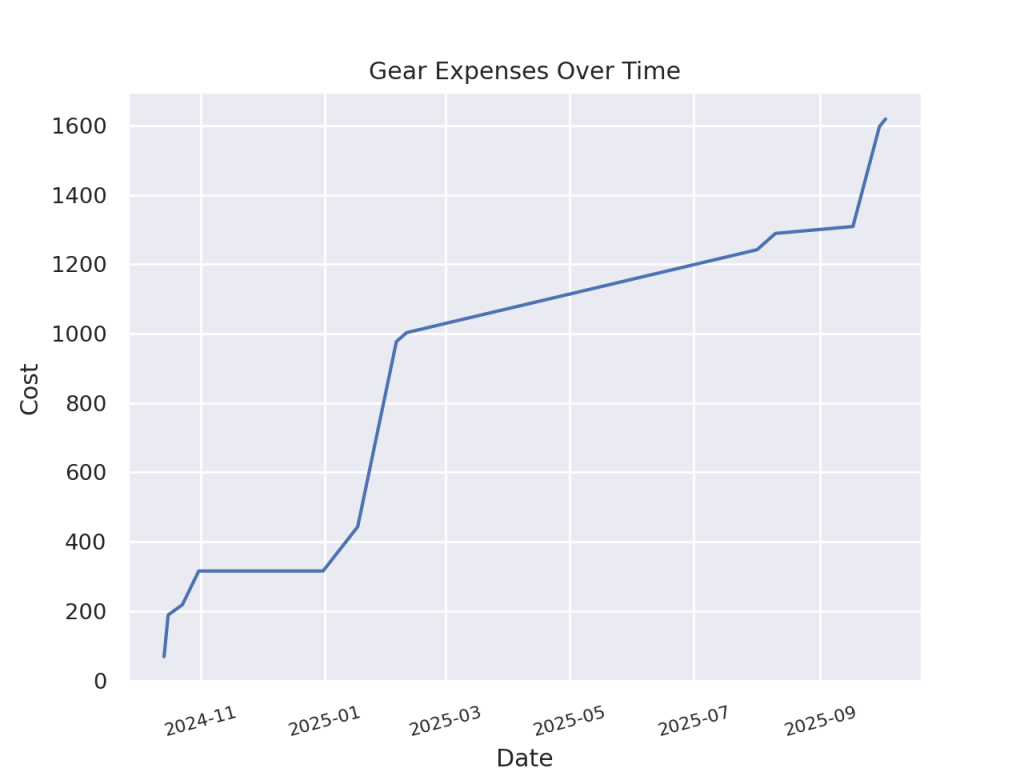
Caption: Money spent (USD $) on camera gear over the last year.
As we can see in the above plot, I spent a little over $1600 on camera gear in the past year, usually making purchases in quick bursts rather than consistently over time. We can see the initial jumps in the first few months when I was buying the Argus and Minolta cameras. This flat lined for some time until I purchased the Leica iif and an Elmar 50mm lens in February. After that the largest purchase I made was a Leica Summaron 35mm lens in August. Overall the Leica is by far my largest investment, making up a little more than half of my spending at $820.
In a sense $1600 is a lot of money, but it’s also nothing in comparison to what I could have spent in this hobby. I could have easily dropped many thousands of dollars if I’d invested into the Leica M line or picked up any of the more highly regarded medium format cameras like the Mamiya 7ii or Hasselblad 500c. I’ve been fairly conservative with my purchases overall, I think, despite the amount of gear I have to work with.
So What’s Next
Honestly the main thing I’m looking forward to is the snow. There’s something magical about it all, which I hope I’ll be able to give justice to on film. The current, dreary weather and early sunsets are leaving a lot to be desired for me right now, so I’m hoping the snow can spice things up.
 Return Home